
Data Science
The fundamental purpose of this course is to provide students with a robust interdisciplinary framework that goes beyond the application of algorithms, integrating theoretical physics and engineering with contemporary computational intelligence. This course seeks to transform the student into a scientific software architect and a probabilistic modeler capable of leading high-level research processes.
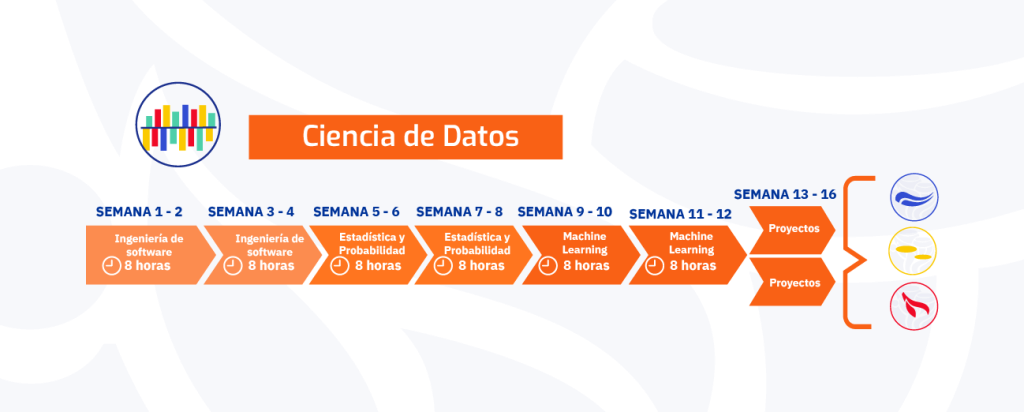
Module 1: Software Engineering for Reproducible Science
Students will be able to: (i) write clear and idiomatic Python for scientific work, (ii) structure research code as a maintainable project, (iii) use version control effectively, (iv) incorporate automated testing, (v) build reproducible environments, and (vi) profile and optimize bottlenecks while preserving correctness.
Module 2: Mathematical Probability for Data Analysis
Students will be able to: (i) model measurements with random variables and PDFs, (ii) estimate parameters and propagate uncertainty, (iii) use maximum likelihood as a unifying principle for estimation, (iv) incorporate systematic uncertainties, (v) perform hypothesis testing with appropriate statistics, and (vi) extend methods to multidimensional data.
Module 3: Machine Learning Techniques for Physicists and Engineers
Students will be able to: (i) formulate physics/engineering problems as ML tasks, (ii) build reproducible pipelines in Python, (iii) train and validate baseline and nonlinear models, (iv) quantify performance with appropriate metrics and uncertainty and calibration checks, and (v) interpret and subject models to stress tests under distributional and systematic shifts.
Faculty Community – Data Science
Module 1
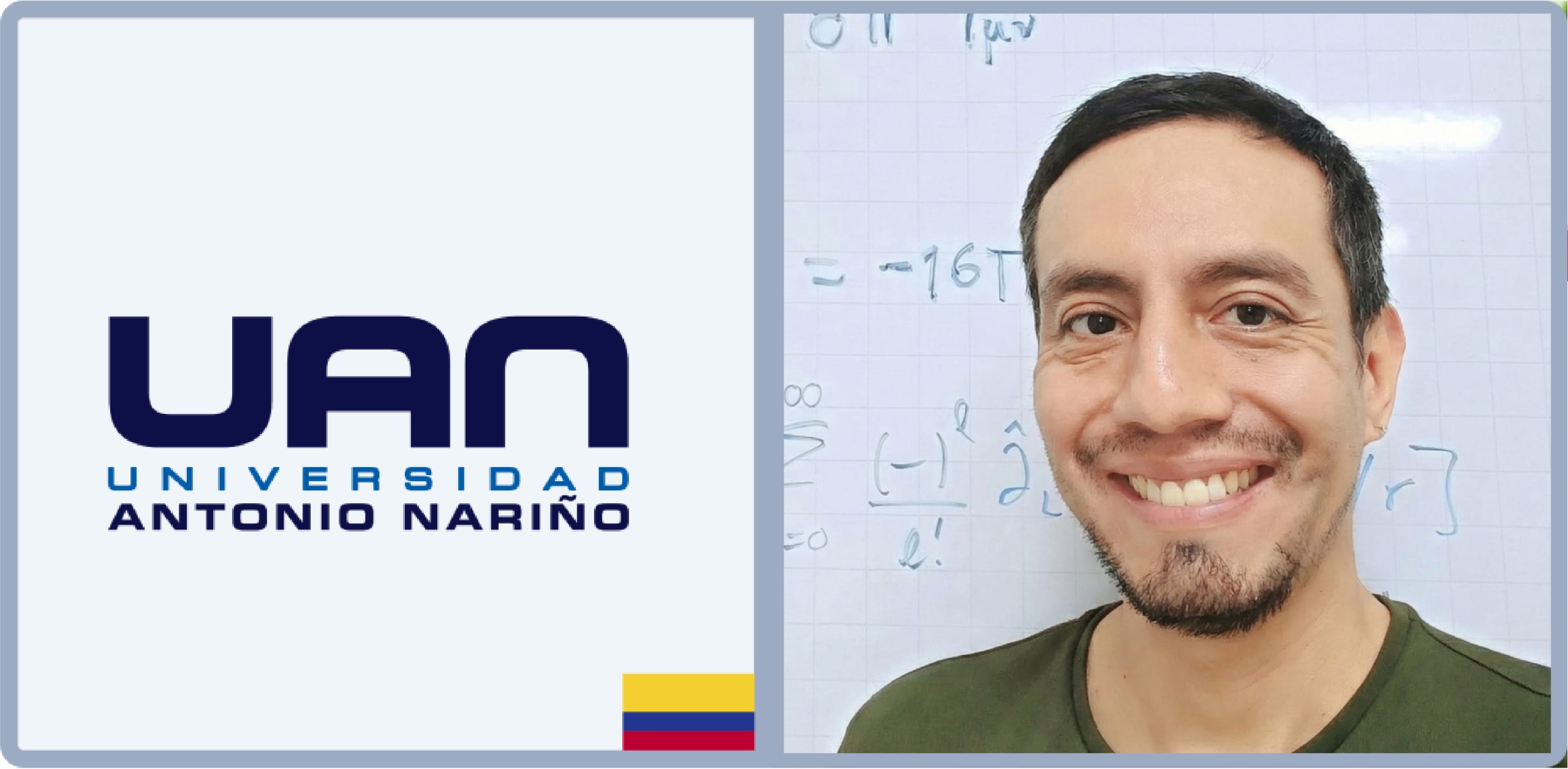
José Fernando Rodríguez
Software Engineering
Professor and researcher at Antonio Nariño University (Colombia). His work focuses on General Relativity, gravitational waves, black holes, and modified gravity theories. Member of ICRANET (Italy).
Module 2

José Ocaríz
Statistics and Probability
Deputy Coordinator of the Project. Franco-Venezuelan particle physicist. Senior professor at Université Paris Cité and researcher at IN2P3. He has actively participated in scientific cooperation programs between France and Latin America.
Module 3

John Samuel
Machine Learning
Associate Professor of Computer Science at CPE Lyon (University of Lyon, France) and researcher at the LIRIS laboratory (CNRS / University of Lyon). He holds a PhD in Computer Science and a habilitation to supervise research (HDR). His work focuses on data science, urban data analysis, machine learning, and knowledge representation. He combines research on algorithms and data systems with applications in artificial intelligence and complex data modeling. His current research explores 3D urban data analysis and knowledge graphs.
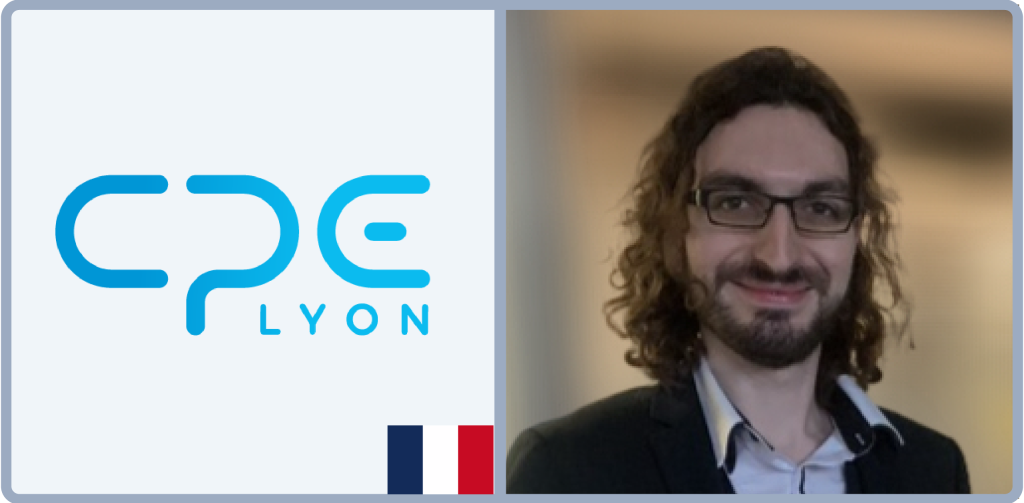
Rémy Chaput
Machine Learning
Associate Professor and researcher in Computer Science at CPE Lyon (University of Lyon, France). He holds a PhD in Computer Science and is a researcher at the LIRIS laboratory (CNRS / Université de Lyon), in the SyCoSMA team (Cognitive Systems and Multi-Agent Systems). His specialties include Artificial Intelligence, particularly reinforcement learning (multi-agent and multi-objective), explainable AI, and responsible/ethical AI.