
Students from Honduras, Venezuela, and Colombia will embark on a research mobility program at universities across Latin America, funded by EL-BONGÓ physics and scheduled for the second semester of the 2026 cohort. The in-person internships will run from October 19 to December 4 as part of the project’s commitment to strengthening scientific training and fostering collaboration among academic communities.
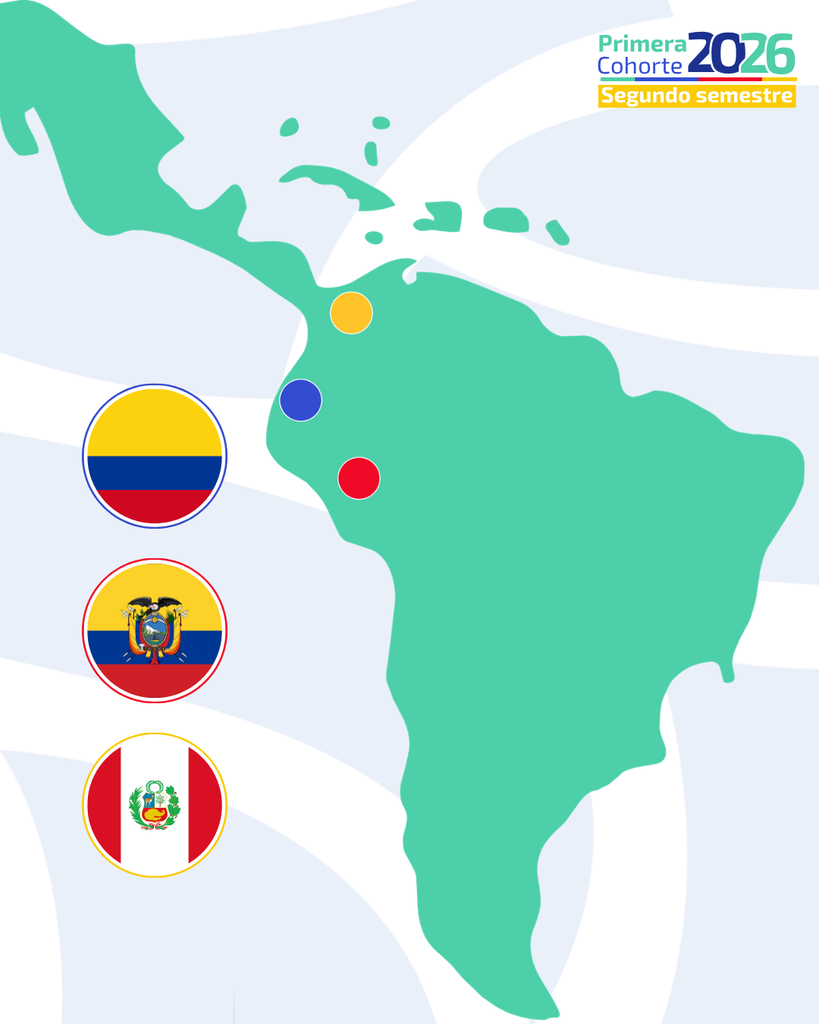
This cohort of interns comprises three graduate students and three advanced undergraduate students who have met the training requirements in astroparticle physics and high-energy physics. The selected students come from the National Autonomous University of Honduras (UNAH), the Central University of Venezuela (UCV), and Antonio Nariño University (UAN) in Colombia. Their projects will be carried out at host institutions in Ecuador (Universidad San Francisco de Quito), Colombia (Universidad Autónoma de Bucaramanga, Universidad Industrial de Santander, and Universidad Antonio Nariño), and Peru (Universidad Nacional Mayor de San Marcos).
The research projects offered as part of the internship program are: AI Agents for High-Energy Physics Analysis Applied to Searches for New Physics Using Open Data; Optimization of Scintillator-Based Cosmic-Ray Detectors for Precision Agriculture; Assembly of Gas Detectors; Nuclear Instrumentation; AI Agents for High-Energy Physics Analysis Applied to Searches for New Physics Using Open Data; and The Relationship Between Forbush Decrease Morphology and Interplanetary Medium Conditions.
Deywis Moreno López, director of UAN’s Detector Laboratory in Colombia and an internship supervisor, explained that welcoming students from other institutions provides an opportunity to enrich the laboratory’s academic and scientific work. “We have always believed that science is built collaboratively,” he noted. He also highlighted the value of bringing together different perspectives and creating opportunities for exchange among students and researchers from across Latin America. Meanwhile, Christian Sarmiento Cano, representing UNAB and also serving as an internship supervisor, emphasized student mobility as one of the strengths of the EL-BONGÓ physics project. He noted that host institutions can help students deepen their knowledge in new areas of research.
The in-person internships will continue through December 4, 2026. To conclude this stage, the six students will present their project results and share reflections on their experiences on December 7 and 8 in Antigua, Guatemala, during the second Bridges in Science gathering (Puentes en la ciencia). This event will provide an opportunity to share the progress achieved and recognize the learning gained through collaborative work within research groups.